Volcanic Eruptions in the Early 1800s Broke a Link Between Two Ocean Basins, 400-Year Records Show
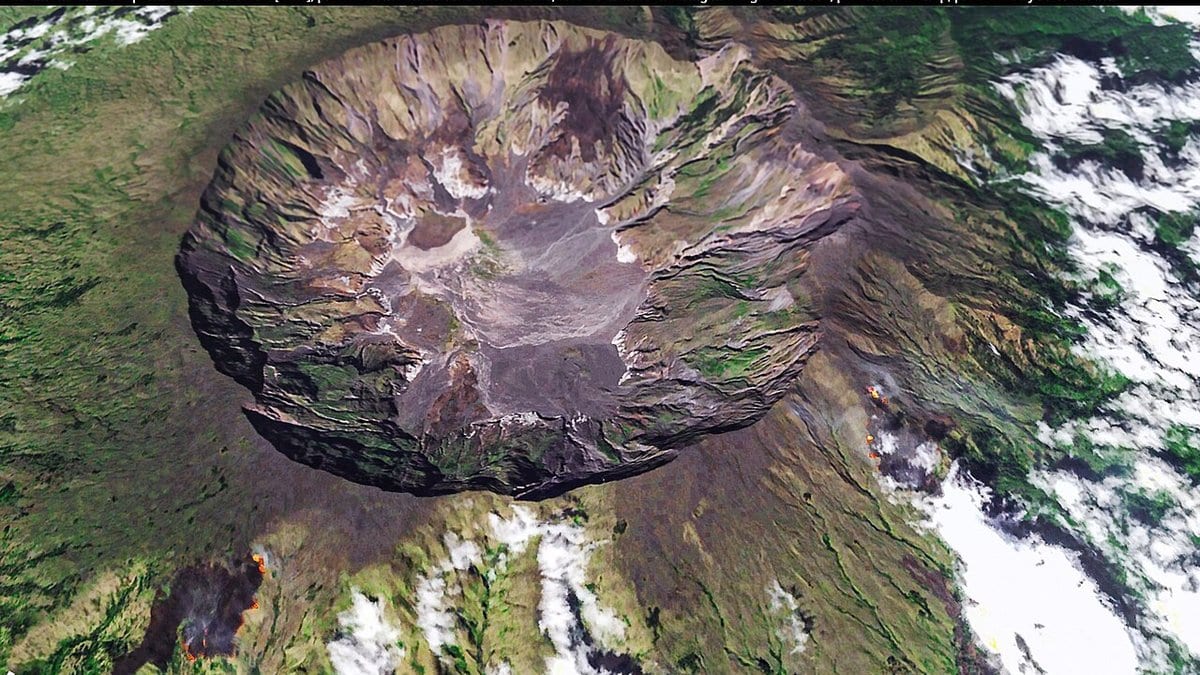
A reconstruction of tropical Indian and Pacific Ocean climate back to the early 1600s finds the two basins moved largely in step until a run of volcanic eruptions in the early 19th century disrupted the connection, according to a study published Aug. 26, 2026, in Nature Communications.
Shawn Wang, Delia Oppo and Caroline Ummenhofer compiled tropical paleoclimate archives, including corals, tree rings and stalagmites, to reconstruct three circulation patterns over the past four centuries: the Indian Ocean Walker circulation, the Indian Ocean basin mode and the Pacific Walker circulation. Wang, the lead author, is a former Woods Hole Oceanographic Institution researcher now at the University of Colorado Boulder, while Oppo and Ummenhofer are at WHOI.
Both Indian Ocean modes were largely coupled to the Pacific throughout the pre-industrial era, but that coupling was disrupted by a series of volcanic eruptions during the early 19th century. WHOI's release dates the disrupted interval from 1810 to 1850, says computer simulations covering the past millennium support the explanation, and points to the 1815 eruption of Mount Tambora in Indonesia as one of that series.
Scientists have observed the two basins' co-variability breaking down since the 1980s, the release notes. The paper's abstract gives the reason for looking further back: the instrumental record is too short to determine whether such a decoupling could also have arisen naturally.
On the recent period, the abstract says the Pacific Walker circulation's relationship with the Indian Ocean basin mode since the mid-20th century "appears exceptional relative to equivalent-length intervals of the past millennium, including periods of strong volcanism."
In the release, the researchers put it more strongly. "With climate models and paleo-records, we are now able to say with more confidence that the recent changes we are seeing are really quite exceptional," Wang said. Ummenhofer added, "A key finding is that global warming and human emissions are now overwhelming the Pacific's natural influence on the Indian Ocean."
The open-access study was supported by the U.S. National Science Foundation, the WHOI Investment in Science Program and the WHOI Academic Programs Office.
Sources
- www.nature.comPeer-reviewed