Satellites Find the Amazon's Carbon and Water Cycles Drifting Apart
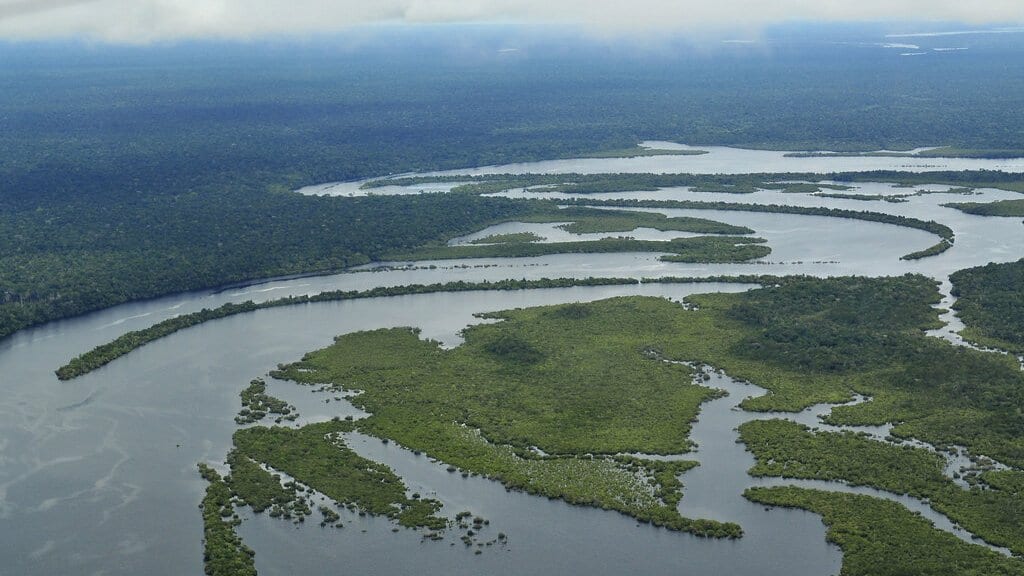
The carbon that Amazon forests take in and the water they give off have been moving further out of step for four decades, an analysis of 40 years of satellite data published Aug. 22 in Nature Communications reports.
Sarah Worden, Nima Madani, and Sassan Saatchi of NASA's Jet Propulsion Laboratory, with co-authors at Pacific Northwest National Laboratory, Washington State University, and the nonprofit Ctrees, compared satellite-based estimates of gross primary production — the carbon plants take up through photosynthesis — against evapotranspiration, the water returned to the air from soil and leaves.
The two are normally expected to be closely linked, because leaves lose water through the same pores that let carbon dioxide in. Across the Amazon Basin, the authors report, 64% of the area shows only weakly positive correlations, below 0.3, or negative ones. In forests with the most water available to begin with, the correlation was minus 0.03, give or take 0.14, which is effectively no relationship.
The gap opens in the dry season, when the two fluxes behave differently, the paper says, and correlation strength has fallen since 1982, most steeply in intact forest. That decline runs alongside a rise in vapor pressure deficit, a measure of how dry the air is.
"We hypothesize that rising VPD suppresses canopy conductance and GPP, while elevating atmospheric demand for ET," the authors write. They state the consequence in the conditional as well: continued decoupling "could increase water loss relative to carbon gain, undermining the Amazon's capacity as a sustained carbon sink."
The research was carried out at JPL under NASA contract 80NM0018D0004, with support from a NASA Postdoctoral Program fellowship and the U.S. Department of Energy's Next Generation Ecosystem Experiment-Tropics.
Sources
- Nature CommunicationsPeer-reviewed