A Chip-Sized Radio Sent Brain Data Through a Cadaver's Head Without Wires
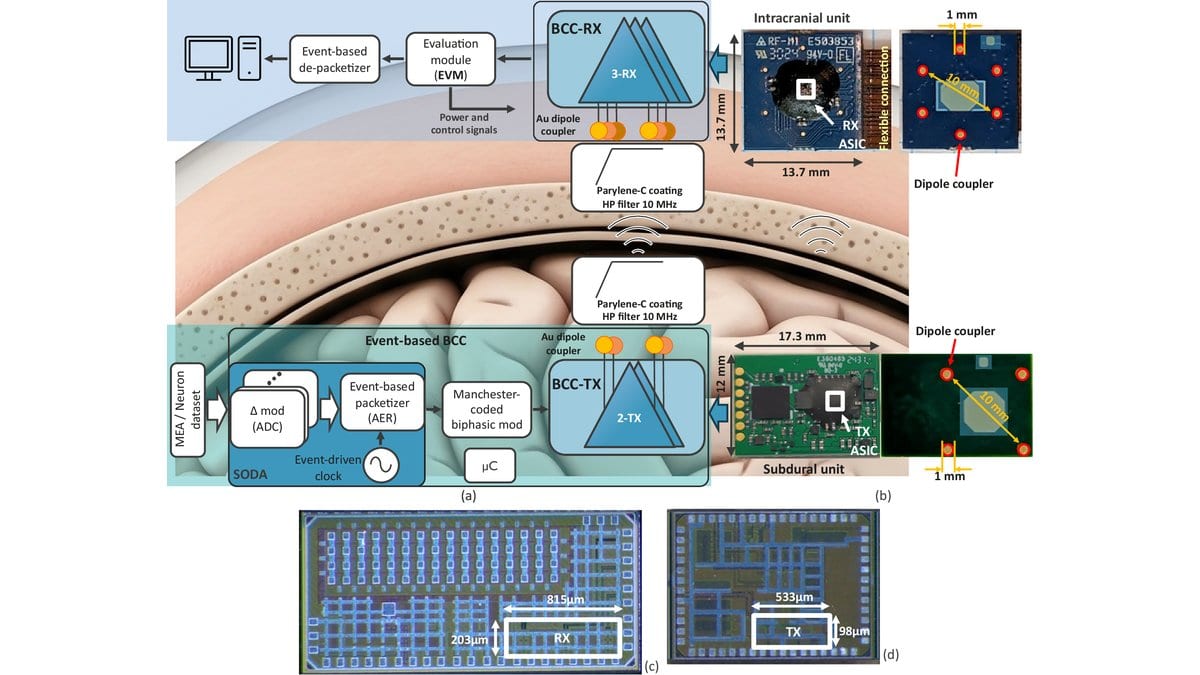
Engineers have sent data out of a mock brain implant as an electrical current through body tissue, with no wire and no antenna. They tested the link inside a human cadaveric head specimen. The system transmitted at up to 500 megabits per second with bit error rates below 10⁻⁵, or under one error per 100,000 bits, according to a paper published Sept. 1 in Communications Engineering.
Implants that read individual neurons are running out of room to send their data. The paper estimates that an array of 1,000 electrodes, each sampled 30,000 times a second by a 10-bit converter, produces about 300 megabits per second. The cable that normally carries it out also holds the array still against a brain that moves, which the authors tie to scarring and signal loss.
The design splits the path in two. A transmitter sits under the dura, the membrane covering the brain, tethered to nothing and integrated with the electrode array; it drives current through tissue to a receiver anchored at a small opening in the skull above. A second link, not built here, would carry the data out of the body.
In the cadaver experiment the subdural unit drew 2.4 milliwatts and ran for about an hour on a button cell, the authors report, transmitting synthetic data generated on-chip rather than recorded neural signals. An encoder transmits only when a neuron fires. The authors report this gives up to 11.4 times compression, or a measured 7 to 12 times once timestamps are counted, letting the transmitter run at roughly a 13 percent duty cycle.
The team also ran the transmitter beside neurons cultured on a chip. It evoked no unintended activity, they write, though cultures directly above the coupling electrodes showed a localized inhibitory response. The paper says this neural-stimulation safety test is, to the authors' knowledge, the first investigation of its kind.
Wireless power for the implant is outside the scope of the work, the paper states, and is left to a future version.
Sources
- www.nature.comPeer-reviewed

Medical Disclaimer: This content is provided for general informational and educational purposes only. It is not medical advice and should not be used as a substitute for professional medical advice, diagnosis, or treatment. Always consult a qualified healthcare professional regarding any medical condition, concern, symptom, or treatment decision.