A Tiny Drone Feels Its Way Through the Dark With Whiskers Like a Rat's
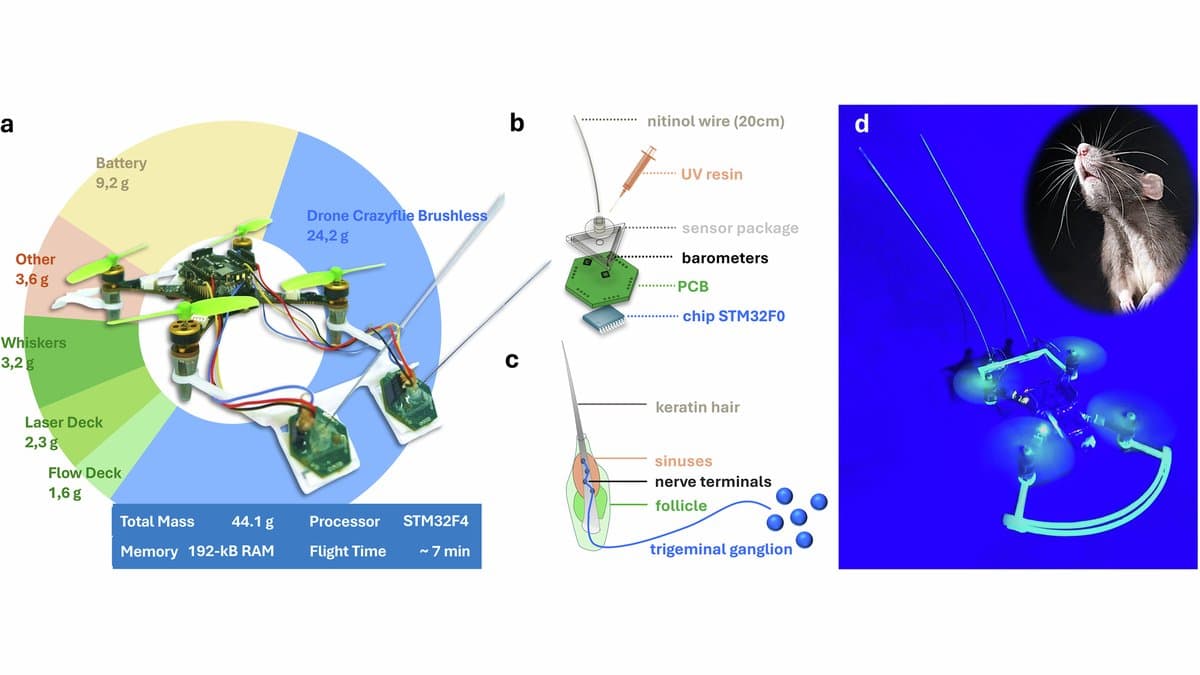
A palm-sized drone has flown through a pitch-dark room, followed the contours of walls and mapped an enclosed space using nothing but a 3.2-gram set of artificial whiskers. Researchers at Delft University of Technology describe the flights in a paper published Sept. 18 in Nature Communications.
The whiskers are aimed at places where sight fails. Cameras and laser rangefinders stop working in smoke, in dust and in darkness, the authors write, and those are exactly the conditions in which a small search-and-rescue or inspection drone would be most useful.
Each whisker is a thin wire with pressure sensors at its base. When the wire bends against a surface, the pressure changes are read as an estimate of how deep the contact is, and the paper reports millimeter-scale accuracy for that estimate. The drone used those readings to steer along walls, to trace both rigid and soft surfaces, and to build a touch map of a closed room and find the exit.
The test aircraft was a 44.1-gram Crazyflie drone carrying two forward-facing whiskers. The whole system ran on the drone's own processor: sensing, filtering, navigation and exploration together used 34 kilobytes of its 192 kilobytes of memory, with no outside computer and no positioning system.
"We wanted to show that touch does not have to come at the cost of size or computational power," said Chaoxiang Ye, the paper's first author, in the university's release.
The work was led by Salua Hamaza, an associate professor at Delft. Her group took the idea from rats, which sweep their whiskers across surfaces to find their way through dark burrows, and the drone sweeps its whiskers along a wall in the same way.
Sources
- nature.comPeer-reviewed