NIST Built a Security Check That Asks Where You Are, Not Who You Are
Researchers at the National Institute of Standards and Technology and an international team have used single particles of light to confirm where a person physically is, rather than trusting a password or a network address. NIST said the experiment, a protocol called quantum position verification, closed loopholes that had left earlier quantum location checks open to fraud.
NIST describes the aim as access tied to a place: only someone who can prove they are inside a bank or a secure building would be able to pull sensitive records or send a command to a power grid. Gautam Kavuri and colleagues published the work Nov. 18, 2026, in Nature.
Per NIST's announcement, the team built two verifying stations 195 meters apart on the agency's Boulder, Colorado, campus, with the person's claimed position between them. One station makes a pair of entangled photons, particles of light whose measurements stay linked, and sends one to that person. Both stations send random numbers timed to arrive together, and those numbers set how the photon has to be measured. The round-trip time of the answer tells the stations where it was measured.
The exchange ran millions of times over a few minutes and then was checked with a loophole-free Bell test: the photons proved more closely correlated than ordinary physics allows. Any error or tampering makes the test fail, and copying the photon for an accomplice destroys the correlations. Someone outside the claimed area would also answer too slowly, because nothing travels faster than light.
Attempts at the scheme go back decades, and "our experiment is the first complete demonstration of such a protocol," said Krister Shalm, a NIST physicist. A usable version is more than a decade away, according to Scott Glancy, another NIST physicist on the study — the quantum networks it would need are still being built.
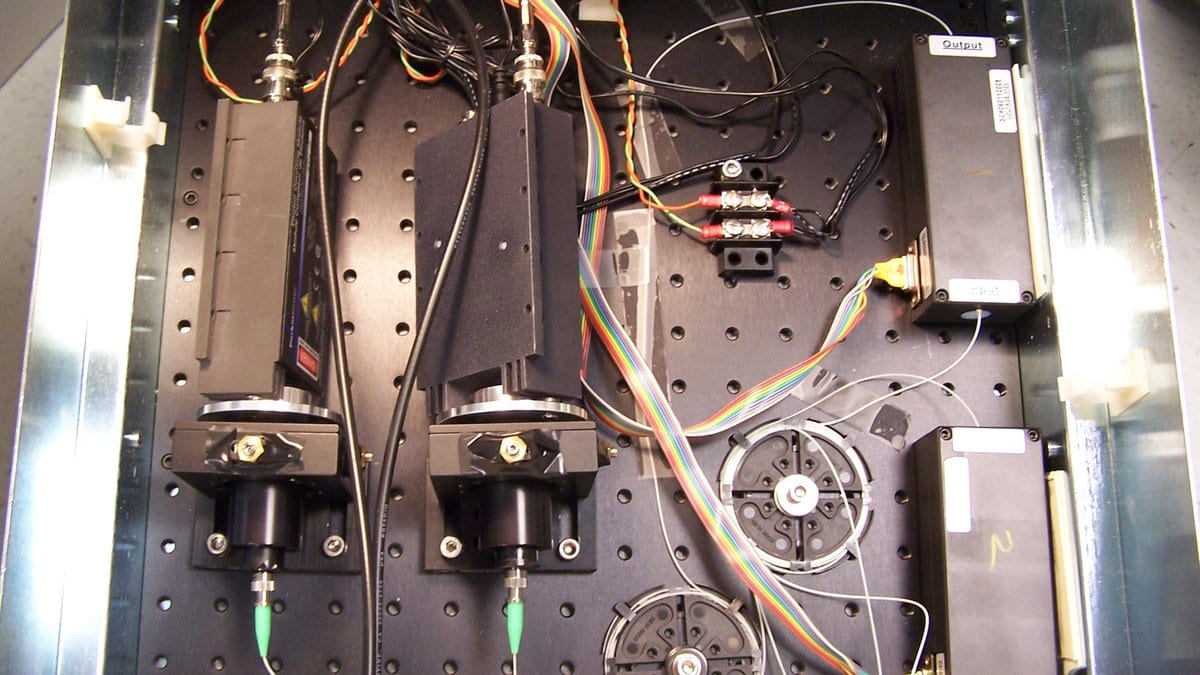
Two NIST technologies made the run possible: detectors that caught nearly every photon and a fast source of entangled photons its scientists built a decade ago.
Sources
- www.nist.gov
- NaturePeer-reviewed